
Picture a dental visit where your dentist repairs a small cavity without touching a drill, or where a simple gel helps regrow enamel you lost years ago. That future sounds distant, but researchers are already testing it on real patients today. Much of this progress comes down to peptides, the same molecules you might recognize from skincare labels or bodybuilding forums. In dentistry, these tiny protein fragments are quietly becoming one of the most exciting tools for repairing teeth, fighting the bacteria that cause cavities, and rebuilding the gum and bone tissue that hold your teeth in place. I still tense up a little at the sound of a dental drill, so anything that could reduce how often a dentist reaches for one has my full attention.
What Are Peptides, Exactly?
So what exactly is a peptide? Put simply, a peptide is a short chain of amino acids, the same building blocks that make up proteins in your body. Think of proteins as long sentences and peptides as the short, useful phrases pulled from them. Your body already relies on peptides for hundreds of jobs, from healing wounds to regulating hormones. Researchers have started asking a simple question. If peptides already know how to build and repair tissue naturally, why not put that same biology to work on teeth and gums? That question has opened a growing field called biomimetic dentistry, a treatment that copies the body’s own repair process instead of only patching over the problem.
Peptides That Rebuild Enamel Instead of Drilling It Away
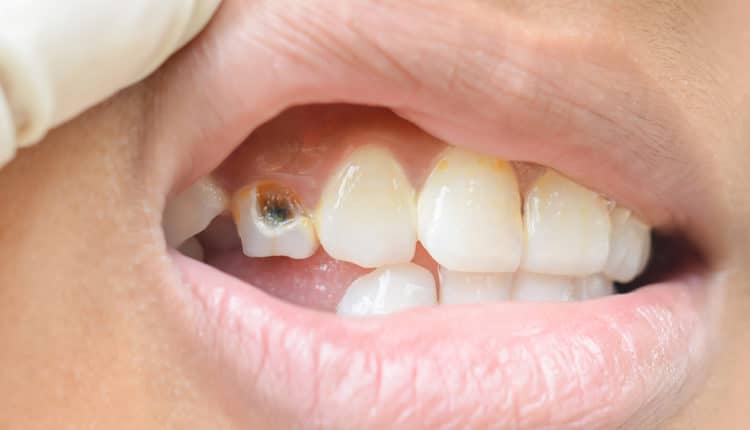
Enamel is the hardest tissue in the human body, but it cannot repair itself the way skin or bone can. Once decay eats through it, a dentist has traditionally had only one real option: drilling out the damage and filling it. Peptide research is starting to offer a second option.
At the University of Washington, researchers built peptides from amelogenin, the protein that forms enamel in the first place. These peptides bind onto tooth surfaces and recruit calcium and phosphate ions, and the peptide-enabled technology allows the deposition of 10 to 50 micrometers of new enamel on the teeth after each use, with the eventual goal of working it into everyday toothpaste and gels. Mehmet Sarikaya, the University of Washington professor who led the study, put it simply. “Remineralization guided by peptides is a healthy alternative to current dental healthcare,” he said.
A similar idea is already sitting in dental offices across Europe. A peptide called P11-4, sold under the brand name Curodont Repair, targets early cavities before they ever need a filling. Its structure is built around matching the spacing of calcium ion binding sites with the calcium spacing found naturally in tooth mineral, so a dentist applies it directly to the tooth, where it assembles itself into a scaffold that mimics real enamel. One short in-office visit is usually all it takes, and the procedure is non-invasive, pain-free, and does not stain the tooth. Randomized, controlled trials out of Germany have tested it directly against standard fluoride varnish. This is not some far-off concept. A dentist can offer it to a patient today.
Peptides That Fight Cavity Bacteria Without Wiping Out the Good Guys
Your mouth hosts more than 750 different types of bacteria, and only a handful of them actually cause harm. Rinses such as chlorhexidine or antibiotics tend to kill everything in their path, good bacteria and bad alike, which feeds into the same rise of antibiotic-resistant bacteria that worries doctors elsewhere in medicine.
Peptide researchers are working on something more precise. One approach fuses a targeting piece built from a bacterial signaling molecule onto a wide spectrum antimicrobial peptide, creating a combination that hunts down Streptococcus mutans specifically while leaving closely related, harmless oral bacteria untouched. Researchers at the University of Pennsylvania took a different route, growing antimicrobial peptides inside plants instead of expensive lab equipment. In testing, these plant grown peptides rapidly killed the bacteria behind cavities and disrupted their ability to form biofilm on a tooth-like surface, and the effect grew even stronger when the peptides were combined with an enzyme that breaks down the matrix protecting the bacteria. Because the peptides come from plants, the team believes the treatment could stay cheap enough to reach people who cannot currently afford advanced dental care.
Peptides That Help Rebuild Gums and Bone
Gum disease does more than make your gums bleed when you floss. Without treatment, it slowly destroys the bone and ligament that hold your teeth in place, and that support does not grow back on its own. This is actually the area where peptide medicine has already reached furthest into mainstream dental care.
A product called GEM 21S combines a synthetic bone scaffold with rhPDGF-BB, a lab made copy of a natural peptide your platelets release when you get injured. A periodontist places it into a bone defect around a tooth, and the growth factor signals cell migration and proliferation among osteoblasts, periodontal ligament fibroblasts, and cementoblasts, which leads to the formation of new alveolar bone, periodontal ligament, and cementum. More than 500 published studies and over 60 clinical studies back the product, which has already been applied in approximately five million patients. Long term data shows new bone filling in between 62 and 87 percent of the treated defect after three years.
Peptides are changing dental implants too. Coating a titanium implant with a peptide called GFOGER, which mimics a specific binding site on natural collagen, triggers osteoblastic differentiation and mineral deposition, and this significantly improves peri-implant bone regeneration and mechanical fixation compared to untreated titanium. A 2025 study pushed the idea even further. Researchers built a peptide coating that responds to inflammation in stages, and it increased the force needed to dislodge an implant by 161 percent compared to an uncoated surface.
Regenerating a Tooth From the Inside Out
If all of this sounds futuristic, one more development might sound like science fiction, except researchers are already testing it on real patients. A company called HysensBio has built a peptide that a dentist applies directly to the tooth surface. From there, it travels down the tubules inside the dentin and reactivates dormant odontoblasts, the cells responsible for building dentin, which then secrete new dentin and rebuild the tooth from the inside.
This is not just an early stage idea. The peptide is currently in a Phase 2 clinical trial in the United States involving 120 patients, targeting dentin hypersensitivity, and it already went through a Phase 2 trial in Korea in 2024 that included 171 patients. The technology won the pitch competition at the American Dental Association Forsyth dentech event, standing out among a strong field of dental technology companies. None of this means the treatment lands in your dentist’s office next year, but it shows how quickly this corner of dentistry is moving from theory to real patients.
What This Could Mean for Your Next Visit to the Dentist
None of this erases the need for good brushing, flossing, and regular checkups. Peptides are not magic, and researchers in this field keep pointing out that most of the evidence still comes from laboratory and animal studies rather than large scale human clinical trials, leaving a wide space for further investigation. Still, Curodont Repair and GEM 21S already prove that peptide based care can move from a lab bench to a real dental chair.
I like this shift. Dentistry has spent decades getting better at repairing damage after it happens. Peptides point toward something different, treatment that works with your body’s own biology to prevent damage or rebuild what you already lost. The next time you sit in that dental chair, do not be surprised if your dentist mentions a peptide based option before reaching for the drill. Ask about it. This field is moving fast enough that what sounds experimental today might sit in your dentist’s supply cabinet within a few years.